
HBY4-10 Full Automatic Brick Production Line Hot Sale In Nigeria
Interlocking Brick Making Machine: Planning a Starter Clay Brick Plant Around the HBY4-10
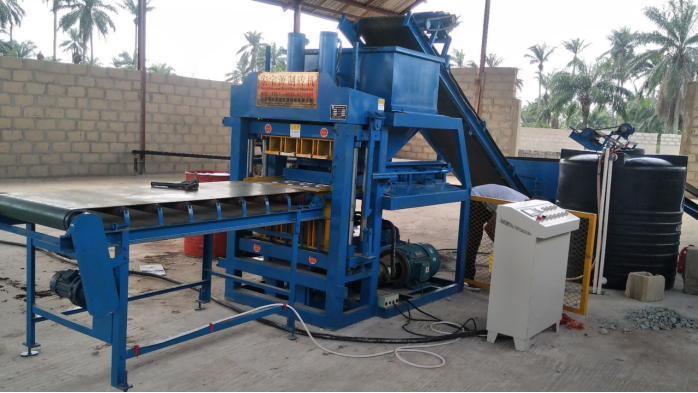
Soil-based interlocking bricks are one of the few construction products where a small plant can compete on cost with an imported block. The HBY4-10 is an interlocking brick making machine built for that entry point: a hydraulic press with a PLC, one brick profile family, and a full line of crusher, screen, and mixer behind it. This is what the plant looks like and what decides whether it works.
Quick answer
- The HBY4-10 is a fully automatic hydraulic brick machine with a 7–10 second cycle and four bricks per cycle.
- It runs on 11 kW, weighs 1,800 kg, and is controlled by a PLC with a touch screen, so one operator can run the machine.
- A working plant needs three supporting units first: a soil crusher, a screening machine, and a mixer with conveyor.
- Brick height is set by adjusting screws; the mold can be changed for a different profile.
- Whether the plant is profitable is decided by soil grading and curing discipline, not by the machine.
What the machine is
| Parameter | Value |
|---|---|
| Model | HBY4-10 |
| Bricks per cycle | 4 |
| Cycle time | 7–10 s |
| Shaping method | Hydraulic pressing |
| Hydraulic pressure | 25–32 MPa |
| Power | 11 kW |
| Total mass | 1,800 kg |
| Overall size | 2,260 × 1,800 × 2,380 mm |
| Rated voltage | 380–440 V, or as requested |
| Control | PLC with touch screen, pressure adjustable from the screen |
The mechanical details that matter in daily use: four guideposts so the mold rises and drops squarely, two cylinders on the top mold and one under the bottom mold pressing from both directions, and proportional valves so the pressure can be adjusted from the touch screen rather than by hand on a gauge. Brick height is changed by adjusting screws, which is what lets one plant supply more than one wall thickness.
The full line, not just the press
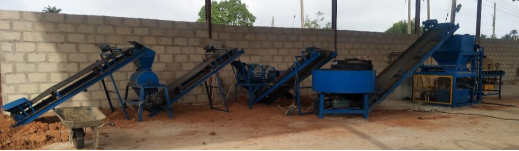
The press is the visible part. A soil brick machine is only as reliable as the three units in front of it, and a brick production line is decided by what comes before the mold.
| Unit | Specification |
|---|---|
| Soil crusher | 5.5 kW, 500 kg/h capacity |
| Screening machine | 1.1 kW, 500 mm diameter |
| Mixer | HY500, 600 L feeding / 500 L discharging, 7.5 kW, 35–40 s cycle, 17–21 m³/h |
| Conveyors | four belts: one 5 m from mixer to machine, three 3 m from crusher to mixer and screen |
The crusher and screen are not optional if the soil has clods or stones. Material that is not broken down and screened produces bricks with voids, and voids are what fail in a wall. The mixer matters for a different reason: an interlocking brick needs the cement distributed uniformly through the soil at a low dosage, and a mixer that leaves streaks produces some bricks that are strong and some that crumble.
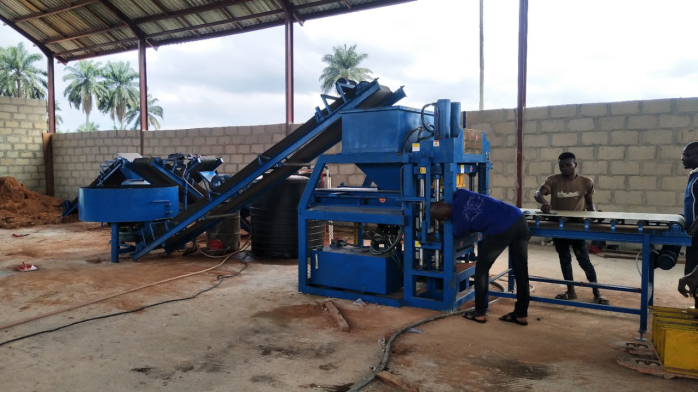
At four bricks per 7–10 second cycle, this clay brick machine can consume material faster than a single small mixer delivers it, which is why the configuration is quoted as a brick production line rather than a machine.
Six checks before you buy any interlocking brick machine
Soil. Get a grading and plasticity check on your soil before ordering. The line is designed to handle soil with a modest cement addition, but "soil" covers everything from clean sandy loam to heavy clay, and the cement ratio that works changes accordingly. A sample test on your own material is the cheapest step in the project and the one most often skipped.
Mold profile. The compressed earth block format is not interchangeable between regions. Buy the profile the local market already builds with; a technically better profile nobody specifies is inventory, not product.
Curing. Compressed earth bricks gain strength over weeks, not hours. A compressed earth block plant that ships bricks at day two is selling a product that will fail later, and the reputational cost lands on the machine. Plan covered curing and a rotation that lets stock sit.
Moisture at mixing. Too dry and the brick does not consolidate; too wet and it deforms on demolding. This is a feel-and-test skill, and it is what the operator training is for.
Power. 11 kW on the press plus 5.5 kW crusher, 7.5 kW mixer, and conveyors is a real load. Confirm your supply can carry it before the container ships, not after.
Spare parts and molds. A wearing item that has to be imported stops the plant. Agree the first spare-parts list and a second mold at order.
What this machine is not
It is not a high-volume concrete block plant. Four bricks per cycle is a starter and small-plant rate, and a buyer who needs paving stones at municipal volume should be looking at an automatic concrete block line instead. Soil brick and concrete block are different products for different buyers: one competes on local material and low cement content, the other on dimensional accuracy and surface finish. Plants that try to serve both from one machine usually serve neither well.
FAQ
How many bricks per hour does an HBY4-10 produce?
At a 7–10 second cycle and four bricks per cycle, the press completes roughly 360 to 500 cycles per hour, which is 1,400 to 2,000 bricks at theoretical rate. Real output is lower once mixing, curing transfer, and shift changes are counted.
Can one person operate it?
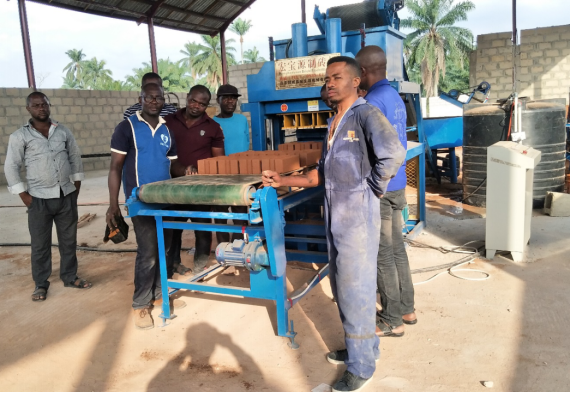
Yes. The machine is PLC controlled with a touch screen, and the pressure and cycle are set from the panel. One operator runs the press; the crusher, mixer, and curing work need people of their own.
What soil does the HBY4-10 need?
Soil that breaks down into a consistent, stoneless mix with a modest cement addition, and a short trial on a clay brick machine will tell you whether yours qualifies. Send a sample and we will test it and confirm the cement ratio and the mold that suits your material.
What are the payment, delivery, and warranty terms?
Payment is T/T, L/C, Western Union, Escrow, or PayPal, with 30% deposit and the balance before shipment. Delivery is within 15 days of deposit. Warranty is one year, and typical machine life is 8–10 years. ISO 9001-2008 and BV certificates are available.
Send a soil sample before you order
The useful first step is not a quotation, it is a test. Send us a soil sample and the brick profile you intend to sell, and we will confirm the cement ratio, the mold, and the line configuration that fits your budget and your power supply. You can also visit the factory or arrange a video walkthrough of a machine under assembly, and we will send the catalog and current price list on request. Hongbaoyuan has built block and brick machinery for more than 5 years and supplies over 17 countries, with ISO 9001:2008 certification. Email [email protected] or call +86-539-8309839.