
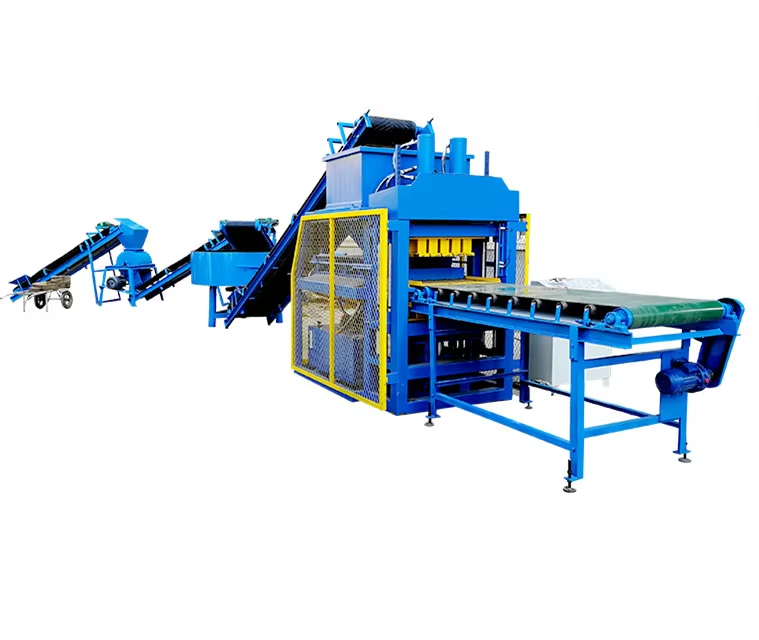
Lower Per-Unit Production Costs with Automated Interlock Block Making Machines
How Integrated Automation Cuts Manufacturing Cost by 35–42%
Automated interlock block making machines transform production economics by replacing manual inefficiencies with precision engineering. These systems integrate computerized batching, vibration compaction, and controlled curing—reducing raw material overuse by 22% and cutting energy consumption through optimized hydraulic cycles. AI-driven quality checks and precision dosing lower rejection rates to under 3.4%, compared to 12% in manual operations, directly reducing per-block cost. Labor efficiency improves dramatically: one machine replaces 15–20 workers while producing 1,500+ blocks per hour. This convergence of material, energy, and labor optimization delivers 35–42% reductions across aggregate, cement, and operational budgets—validated by industry benchmarks from the Bureau of Indian Standards (BIS) and field data compiled by the Construction Industry Development Council (CIDC).
Real-World Impact: Pune Contractor Saves ₹18.7 Lakhs Annually on Block Procurement
A Pune-based infrastructure firm achieved rapid ROI by shifting to on-site automated block production. Installing a single interlock block making machine eliminated third-party procurement markups and transportation fees—previously accounting for 28% of their block budget. Dry-stack compatibility reduced mortar use by 60%, while the machine’s 10,000-block daily capacity aligned seamlessly with phased project timelines. With zero material wastage and no idle labor costs, the contractor documented ₹18.7 lakhs in annualized savings within eight months—demonstrating strong economic viability for mid-scale projects.
Reduced Labor and Material Dependency Through Interlock Block Making Machine Efficiency
60% Less Mortar Required vs. Conventional Bricklaying
Interlock blocks eliminate the need for mortar joints through precise geometric interlocking—reducing mortar consumption by 60% compared to conventional bricklaying. This cuts material costs significantly while accelerating construction speed. Structural integrity is maintained via mechanical interlock rather than adhesive bonding, meeting load-bearing requirements outlined in IS 15658:2006 for interlocking concrete paving blocks.
Dry-Stack Assembly Minimizes Need for Skilled Masons
Dry-stack installation simplifies construction to basic block placement, reducing reliance on certified masons by up to 70%. General laborers require minimal training to achieve consistent, code-compliant assembly. This flexibility supports workforce scalability across diverse sites—especially valuable amid India’s ongoing skilled labor shortage, as reported by the National Skill Development Corporation (NSDC).
On-Site Flexibility and Scalable Output from Interlock Block Making Machines
Eliminating Transportation Costs: Up to 28% Savings via On-Site Production
Producing interlocking blocks directly at the construction site removes logistics dependencies entirely. This eliminates fuel, vehicle maintenance, and driver labor costs—accounting for up to 28% of total block expenditure, according to CIDC’s 2023 Logistics Cost Benchmarking Report. On-site manufacturing also prevents transit-related damage, ensures immediate availability, and avoids storage fees—accelerating timelines and enabling deployment in remote or infrastructure-constrained locations.
Modular Daily Capacity (3,000–12,000 Blocks) Matches Project Timeline Phasing
These machines offer scalable output—from 3,000 to 12,000 blocks per day—enabling precise alignment with construction phasing. Operators can start at lower volumes (3,000–5,000 blocks/day) during foundation and substructure work, then scale to peak output without adding equipment. This prevents overproduction waste and maintains workflow continuity. Post-phase reallocation across multiple sites further maximizes asset utilization and strengthens ROI—particularly beneficial for contractors managing concurrent projects.
Long-Term Lifecycle Savings of Interlocking Concrete Blocks
Interlocking concrete blocks deliver compelling long-term value beyond upfront production savings. Their mechanical interlock enhances structural stability, reducing maintenance interventions by 30–40% over traditional brick walls, per lifecycle assessments conducted by the Central Building Research Institute (CBRI). Built-in moisture resistance mitigates erosion and freeze-thaw degradation, supporting functional lifespans exceeding 50 years in most Indian climatic zones. When produced using an interlock block making machine, optimized density and uniformity improve thermal performance by up to 25% versus conventional masonry—lowering HVAC demand and energy bills. Combined with near-zero replacement requirements over decades, these attributes translate to 60–70% lower lifetime ownership costs compared to clay bricks or cast-in-place alternatives.
FAQ
What are automated interlock block making machines?
Automated interlock block making machines are advanced manufacturing systems that automate the production of interlocking blocks, integrating batching, vibration compaction, and controlled curing for increased efficiency and reduced manual labor.
How do automated machines reduce production costs?
These machines cut production costs by optimizing material use, reducing energy consumption, enhancing labor efficiency, and decreasing rejection rates—resulting in an overall reduction of 35–42% in manufacturing costs.
What is the economic impact of using these machines?
The use of these machines removes third-party procurement costs, reduces transportation expenses, and lowers labor and material costs, leading to significant savings exemplified by the ₹18.7 lakhs annual savings of a Pune contractor.
Do these machines require skilled labor for operation?
No, these machines require minimal training for operation, allowing general laborers to efficiently produce code-compliant block assemblies.
How do interlock block making machines benefit construction projects?
They provide on-site manufacturing flexibility, eliminate transportation costs, ensure immediate availability of blocks, and support scalable production aligned with project timelines.
Table of Contents
- Lower Per-Unit Production Costs with Automated Interlock Block Making Machines
- Reduced Labor and Material Dependency Through Interlock Block Making Machine Efficiency
- On-Site Flexibility and Scalable Output from Interlock Block Making Machines
- Long-Term Lifecycle Savings of Interlocking Concrete Blocks
- FAQ