
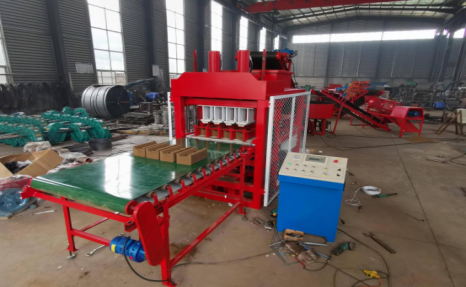
Core Mechanism: Vibration and Compaction for Uniform Density and Strength
Controlled Vibration Frequency and Pressure Distribution
Advanced interlock block making machines apply calibrated vibration—typically in the 8–12 kHz range—to eliminate air pockets and ensure uniform compaction across the mold. Research demonstrates that modulating frequency during compaction increases material density by 18–22% compared to static pressure alone. Amplitude is dynamically adjusted to match mix characteristics: cohesive soils respond best to higher frequencies that induce particle resonance, while granular blends require tailored pressure profiles. This precision prevents localized weak zones that undermine load-bearing capacity and long-term durability.
Precision Compaction’s Direct Impact on Compressive and Flexural Strength
Compaction quality directly governs mechanical performance. Industry data confirms that suboptimal techniques reduce structural integrity by up to 40%, introducing porosity that accelerates corrosion in reinforced applications. In contrast, machines maintaining strict control over vibration duration and hydraulic pressure (≥15 MPa) consistently deliver blocks with compressive strength exceeding 35 MPa. This same precision boosts flexural resistance by 25–30%, a critical advantage for interlocking systems where joint failure can trigger cascading structural compromise.
Automation and Control: Ensuring Batch-to-Batch Consistency
PLC-Driven Parameter Locking for Repeatable Interlock Block Making Machine Output
Programmable Logic Controllers (PLCs) eliminate human variability by digitally locking key parameters—including vibration frequency, compaction pressure, and cycle time—once optimized for high-strength output. These settings are enforced across all batches, delivering uniform density within ±2% variance and consistent compressive strength above 20 MPa per block. Facilities using PLC automation report a 37% reduction in waste from dimensional inconsistencies and maintain flexural strength tolerances of ±0.5 N/mm², as documented in the Construction Materials Journal (2023).
Real-Time Monitoring of Material Feed, Vibration Duration, and Ejection Force
Modern machines integrate IoT sensors to continuously monitor three critical process variables:
- Material feed volume, with alerts triggered at deviations beyond ±1.5% tolerance
- Vibration duration, calibrated to 8–12 seconds for optimal aggregate settlement
- Ejection force, held steadily between 12–15 kN to avoid micro-cracking
Immediate operator alerts enable real-time corrections before defective units form—cutting batch rejection rates by 29% and ensuring dimensional accuracy within 1 mm, essential for seamless interlocking installation.
Design Integrity: How Machine Architecture Supports Structural Reliability
The machine’s physical architecture underpins block reliability through robust frame design, micron-level alignment, and effective vibration isolation. Heavy-duty welded steel frames withstand cyclic operational stresses exceeding 50 tons, preserving dimensional stability over thousands of cycles. Laser-calibrated mold positioning—accurate to ±0.1 mm—ensures even force distribution and eliminates weak zones. This synergy of rigidity and precision is fundamental to achieving the consistent 15–20 MPa compressive strength verified against ASTM C1318 and IS 15658 standards.
| Design Feature | Structural Impact on Blocks | Failure Prevention Mechanism |
|---|---|---|
| Reinforced steel frame | Maintains mold alignment under high stress | Prevents dimensional deviations |
| Vibration-dampening mounts | Isolates external kinetic interference | Eliminates internal microfractures |
| Modular mold system | Ensures uniform pressure distribution | Avoids localized weakness in blocks |
Together, these features ensure every interlocking block resists environmental stressors—including freeze-thaw cycling and dynamic loading—extending infrastructure service life without compromising safety margins.
Operational Best Practices to Maximize Interlock Block Making Machine Performance
Optimal Mix Design and Moisture Control for High-Strength Interlock Blocks
Structural performance begins with precise mix design and moisture management. Validated proportions—commonly 1:3:0.5 (cement:sand:water)—are essential to achieve ≥25 MPa compressive strength. Excess water reduces density by 15–20%; insufficient hydration leads to premature cracking. Real-time moisture sensors in hoppers maintain optimal 8–10% moisture content, ensuring complete and uniform hydration. This minimizes voids and delamination—critical for retaining walls, pavements, and other load-bearing applications.
Preventive Maintenance and Calibration Protocols for Long-Term Consistency
Consistent output demands disciplined maintenance. Key protocols include:
- Daily vibration table alignment verification (±0.5 mm tolerance)
- Bi-weekly calibration of PLC pressure sensors
- Quarterly mold inspections for wear exceeding 0.3 mm depth
Neglecting these steps increases defect rates by 30% within six months. Automated lubrication systems extend component life, while force gauges confirm ejection mechanisms sustain the required 12–15 kN output. This rigor ensures batch-to-batch dimensional accuracy (±1 mm) and strength consistency—non-negotiable requirements for public infrastructure and certified construction projects.
FAQ
What role does vibration play in block making?
Vibration helps eliminate air pockets and ensures uniform compaction, which increases material density and prevents localized weak zones.
How does PLC automation contribute to machine performance?
PLC automation locks in key parameters for consistency, reduces waste, and maintains strength and dimensional tolerances.
Why is precise mix design important for interlock blocks?
Precise mix design is crucial for achieving high compressive strength and preventing issues associated with excess or insufficient moisture.
What are the consequences of improper maintenance?
Improper maintenance can lead to increased defect rates, decreased component life, and compromised block consistency.