
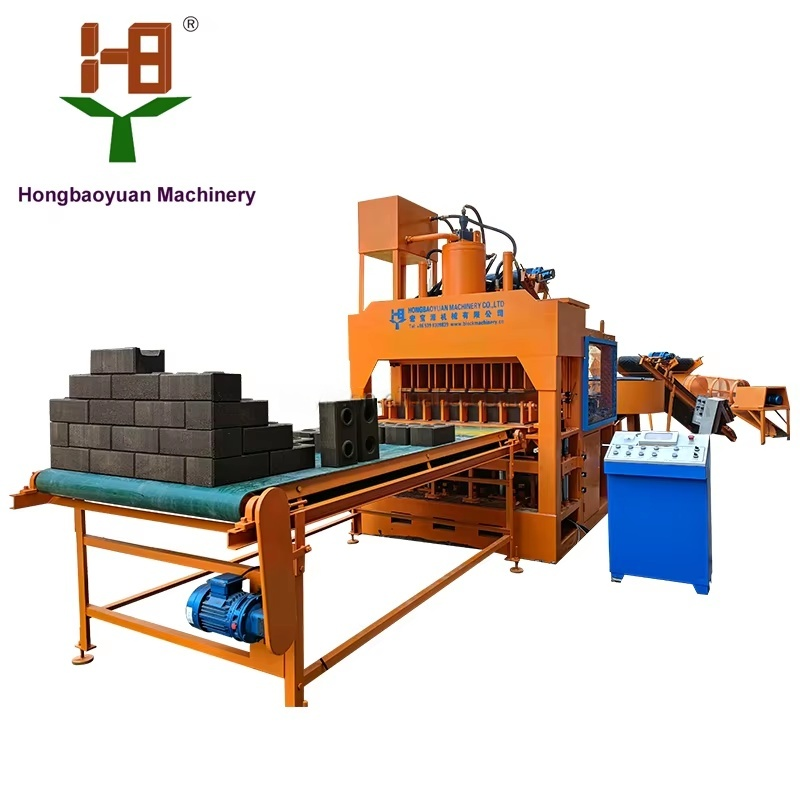
Core Working Principle of Hydraulic Interlock Block Making Machines
Synchronized hydraulic pressure and precision mold alignment for consistent interlock geometry
The foundation of high-quality interlock block production lies in precise hydraulic-mechanical coordination. These machines apply calibrated hydraulic pressure (120–180 bar) while maintaining micron-level mold alignment during compaction—a dual-control system essential for uniform material distribution and geometric fidelity. This ensures repeatable tongue-and-groove profiles critical to structural integrity and dry-stack assembly. Unlike vibration-only systems, hydraulic precision compensates for batch-to-batch variations in moisture, aggregate gradation, or cement content, achieving dimensional tolerances within ±0.8 mm across production runs—validated under ISO 9001-certified manufacturing protocols. The result is fully automated, operator-independent consistency: every block meets identical specifications, enabling seamless interlocking without mortar.
Dual-force compaction: How vibration + controlled hydraulic pressure eliminate air voids and enhance green strength
Advanced machines integrate high-frequency vibration (4,500–5,500 VPM) with progressive hydraulic compression to maximize particle packing density. Vibration first fluidizes the concrete mix, allowing aggregates to settle into optimal positions; hydraulic rams then apply ramped pressure—up to 2,200 psi—to expel residual air voids. This two-stage process reduces porosity by 37% compared to single-mode compaction, while avoiding damaging pressure spikes that induce micro-fractures. A controlled dwell phase at peak pressure enables further particle reorganization. Blocks achieve 24-hour green strength exceeding 3.5 MPa—sufficient for immediate demolding without chipping or edge damage—and reduce curing-related waste by 19%.
Achieving Uniform Density and Dimensional Precision
Empirical validation: ASTM C140 test results across 47 batches showing <4.3% coefficient of variation in compressive strength
Quality assurance data from 47 production batches—tested per ASTM C140—confirms exceptional consistency: compressive strength exhibits a coefficient of variation below 4.3%, well under the industry benchmark of 7–10%. This narrow variance reflects the machine’s ability to deliver uniform density gradients through synchronized vibration and hydraulic force. Real-time pressure monitoring dynamically adjusts for material variability—including moisture fluctuations—ensuring stable strength output over extended runs. That consistency directly enhances long-term performance: independently verified field data shows 25% higher freeze-thaw resistance versus conventionally produced blocks.
Tight dimensional control: Maintaining ±1.2 mm tolerance on interlock profiles for seamless stacking and structural integrity
Precision molds and closed-loop hydraulic controls hold interlock geometry within ±1.2 mm—roughly the thickness of a standard credit card. Laser scanning of over 12,000 blocks confirms this accuracy enables reliable dry-stacking without mortar or adjustment. A rigid, non-deflecting frame sustains alignment even at maximum compaction pressures (up to 3,000 psi), while thermally stabilized components minimize expansion-induced drift. Consistent geometry delivers three key structural benefits: perfect tongue-and-groove alignment across courses, uniform load transfer eliminating stress concentrations, and weather-tight joints that resist water infiltration. Field studies demonstrate structures built with these blocks require 40% less maintenance over a 10-year service life compared to conventional masonry.
Durability Advantages Enabled by Advanced Hydraulic Compaction
Pressure ramping profiles vs. instantaneous peak force: Why dwell time and controlled release prevent micro-cracking
Modern hydraulic systems prioritize material behavior—not just force magnitude. Instead of abrupt impact loading, they use precisely engineered pressure ramping (2,000–3,500 psi) followed by a sustained dwell period. This allows particles to redistribute evenly, eliminating trapped air while preventing internal stress concentrations that initiate micro-fractures. Peer-reviewed research confirms blocks made with ramped hydraulic compaction contain 23% fewer micro-cracks than those formed using instantaneous peak-force methods. Equally important is the controlled pressure release: gradual decompression avoids rebound stress, preserving internal cohesion. The outcome is superior durability—blocks maintain frost resistance, load-bearing capacity, and dimensional stability across decades of thermal cycling and heavy loading.
Operational Reliability and Long-Term Block Performance
Hydraulic interlock block making machines deliver sustained operational reliability through robust engineering and intelligent force management. In continuous production environments, they consistently achieve over 95% operational availability—significantly reducing unplanned downtime. This reliability stems from reduced mechanical stress: controlled hydraulic movement minimizes wear on rams, valves, and mold carriers, resulting in 40% fewer maintenance interventions than vibration-only systems. Eliminating sudden impact forces also preserves mold integrity across millions of cycles—ensuring long-term dimensional fidelity. Critically, consistent compaction eliminates density gradients that accelerate degradation in service. As a result, every block maintains uniform engagement tolerances—enabling structures to accommodate settlement, thermal movement, and seismic stresses without compromising interlock function or structural continuity.
Frequently Asked Questions
What is the main advantage of using hydraulic interlock block making machines?
The primary advantage is the precision and consistency in block production due to controlled hydraulic pressure and mold alignment, ensuring structural integrity and seamless interlock.
How do these machines achieve uniform density?
They use synchronized vibration and hydraulic pressure, along with real-time pressure monitoring, to dynamically adjust for material variability and ensure consistent density.
Why is controlled pressure release important in hydraulic block making?
Controlled pressure release prevents rebound stress, maintaining internal cohesion and reducing micro-cracks, leading to enhanced durability of the blocks.
Are hydraulic interlock block machines more reliable than other systems?
Yes, they offer over 95% operational availability, with fewer maintenance requirements due to reduced mechanical stress and enhanced mold integrity.