
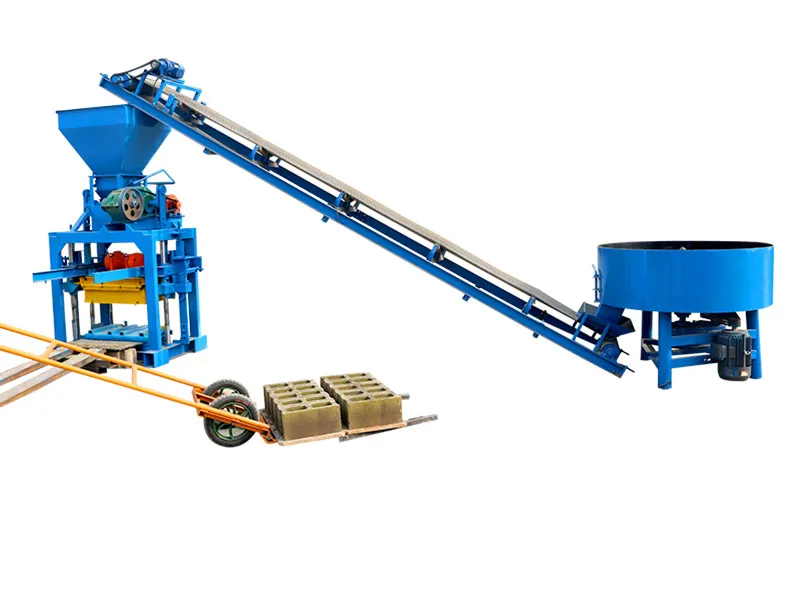
Reducing Labor Costs Through Automation in Block Production About Concrete Block Making Machine
Labor Requirement Reduction Using Automated Concrete Block Machines
Today's concrete block manufacturing equipment cuts down on manual work by around 70% thanks to built-in robots and smart quality checks according to Sanlian Block Machinery data from last year. Back in the day, factories needed anywhere between 20 to 30 people handling everything from mixing materials to shaping blocks and letting them cure properly. Now most plants run with only 3 or 4 techs keeping an eye on things as machines do most of the heavy lifting. Industry reports show that semi-automatic models can crank out about 800 blocks every hour using roughly half the staff compared to old-fashioned methods. And those fully automated production lines? They're hitting well over 2000 blocks per hour these days.
Manual vs. Machine-Based Production: Efficiency and Cost Comparison
| Production Type | Output/Hour | Workers Required | Labor Cost/Year |
|---|---|---|---|
| Manual Block Making | 432 blocks | 20–30 | $740,000 |
| Automated Block Production | 2,000+ blocks | 3–5 | $220,000 |
Data from the Concrete Manufacturing Efficiency Report (2023) shows automated systems cut annual labor expenses by 70% while doubling output consistency.
Balancing Job Displacement Concerns with Long-Term Cost Efficiency
Automation does cut down on how many workers are needed right away, but smart factories find ways around this by investing in training their existing staff. Take one factory in Ghana for instance they went from needing 15 people down to just 6 after introducing semi-automatic equipment. The savings were impressive too about eleven thousand five hundred dollars each month while still keeping production levels steady. According to recent studies, when companies focus on retraining employees instead of laying them off, they see employee retention improve by roughly forty percent. Plus these investment costs get recouped pretty quickly usually within eighteen to twenty-four months once productivity starts climbing again. Ponemon Institute reported similar findings back in 2023.
Accelerating Output with High-Speed, Continuous Manufacturing
Faster Production Cycles Enabled by CNC and Automation Technology
Today's concrete block makers can knock out cycles about 20% quicker than older models thanks to CNC technology and automatic material movement systems. What these machines do automatically now was once all done by hand. They tweak things like the mix ratios, how hard they vibrate the mixture, and even control when blocks cure properly. According to research from last year, factories running fully automated lines typically churn out between 1,800 to 2,400 blocks every hour. That's pretty impressive compared to the 1,200 blocks per hour rate seen in places still using semi-automatic equipment. And get this: dimensional errors stay below 7%, which is actually quite remarkable considering how many blocks get made.
Achieving 40% Faster Output: Case Study of a Fully Automatic System
A 12-month analysis of a 24/7 operational plant demonstrated 10,200 blocks produced per 8-hour shift–a 40% increase over previous manual methods. Key factors included robotic palletizing eliminating 22 minutes/hour of labor gaps, integrated curing chambers reducing wait times between phases, and real-time sensors optimizing raw material consumption to 98.3% efficiency.
Minimizing Downtime and Maximizing Uptime in Continuous Production
Advanced predictive maintenance protocols in fully automatic systems achieve 89% equipment uptime according to 2024 industry data. Thermal imaging detects bearing wear 72+ hours before failure, while automated lubrication systems prevent 93% of motor breakdowns. This contrasts with manual operations experiencing 15–20% downtime from shift changes and mechanical oversights.
Boosting Overall Production Efficiency with Modern Block Machines
Modern concrete block making machines transform production through three critical efficiency drivers: output scalability, precision engineering, and automated workflow management.
Productivity Advantages of Automatic Concrete Block Making Machines
Fully automated systems eliminate manual material handling and quality checks, enabling 24/7 operations with minimal supervision. Advanced models achieve:
| Metric | Automatic Machines | Semi-Automatic Systems |
|---|---|---|
| Hourly Output | 1,500–3,000 blocks | 500–1,200 blocks |
| Labor Per Shift | 1–2 operators | 4–6 workers |
| Daily Uptime | 95–98% | 75–85% |
As highlighted in a 2022 automation efficiency study, these systems reduce idle time through self-diagnostic sensors that preemptively flag maintenance needs.
Data Insight: Triple Daily Output Compared to Semi-Automatic Systems
Facilities upgrading to fully automatic machines report 300% higher daily output versus semi-automatic setups. One plant increased production from 8,000 to 24,000 blocks daily while cutting labor costs by 58%–a shift made possible by simultaneous mold filling and robotic stacking.
Best Practices for Maximizing Efficiency in Machine Operation
- Preventive Maintenance: Replace wear-prone components like vibration motors every 6–12 months
- Operator Training: Cross-train staff on IoT performance dashboards to monitor energy use and block density in real time
- Material Optimization: Use calibrated aggregate-to-cement ratios (typically 6:1) to prevent mold wear
Plants implementing these strategies achieve 31% fewer unplanned stops. Pairing scheduled upkeep with data-driven adjustments ensures peak machine throughput across projects.
Comparing Automation Levels: Manual, Semi-Automatic, and Fully Automatic Systems
Performance and Scalability Across Different Automation Levels
Modern concrete block making machines demonstrate stark efficiency contrasts across automation tiers:
| Metric | Fully Automatic Systems | Semi-Automatic Systems | Manual Systems |
|---|---|---|---|
| Output/Hour | 500–700 blocks | 200–300 blocks | 50–80 blocks |
| Labor/Shift | 1–2 operators | 3–5 workers | 6–8 workers |
| Error Rate | <0.5% | 2–3% | 4–6% |
Recent industry studies show fully automatic systems achieve 92% higher throughput than semi-automated models while reducing labor costs by 82%. Scalability advantages emerge through modular designs that let manufacturers increase production capacity by 150–400% without requiring additional floor space.
Cost-Benefit Analysis of Investing in Fully Automatic Systems
While manual block machines cost $15k–$25k upfront, fully automatic systems ($85k–$220k) deliver triple ROI over 7–10 years through:
- 67% lower per-unit labor costs
- 40% reduction in material waste
- 30% faster production cycles
A 2023 economic analysis found that upgrading to full automation typically achieves breakeven within 18–30 months. Maintenance costs remain comparable across systems at $0.02–$0.05 per block, making automation’s labor savings its decisive financial advantage.
FAQ Section
What is the main advantage of using automated concrete block machines?
The primary advantage is a significant reduction in labor costs while boosting production efficiency. Automated machines can produce more blocks per hour with fewer workers.
How much can labor costs be reduced by automation?
According to the article, automated systems can cut annual labor expenses by approximately 70%, boosting output consistency and efficiency.
What are the benefits of fully automatic systems compared to semi-automatic systems?
Fully automatic systems offer about 300% higher daily output compared to semi-automatic systems, while also achieving significant reductions in labor costs and idle time.
How long does it take for companies to recoup investments in automation?
Investment costs for automation are typically recouped within 18–24 months, although this can vary depending on specific circumstances and production levels.
Does automation impact job availability?
While automation reduces the immediate need for manual labor, companies are increasingly retraining employees, affecting long-term job stability positively.
Table of Contents
- Reducing Labor Costs Through Automation in Block Production About Concrete Block Making Machine
- Accelerating Output with High-Speed, Continuous Manufacturing
- Boosting Overall Production Efficiency with Modern Block Machines
- Comparing Automation Levels: Manual, Semi-Automatic, and Fully Automatic Systems
-
FAQ Section
- What is the main advantage of using automated concrete block machines?
- How much can labor costs be reduced by automation?
- What are the benefits of fully automatic systems compared to semi-automatic systems?
- How long does it take for companies to recoup investments in automation?
- Does automation impact job availability?