
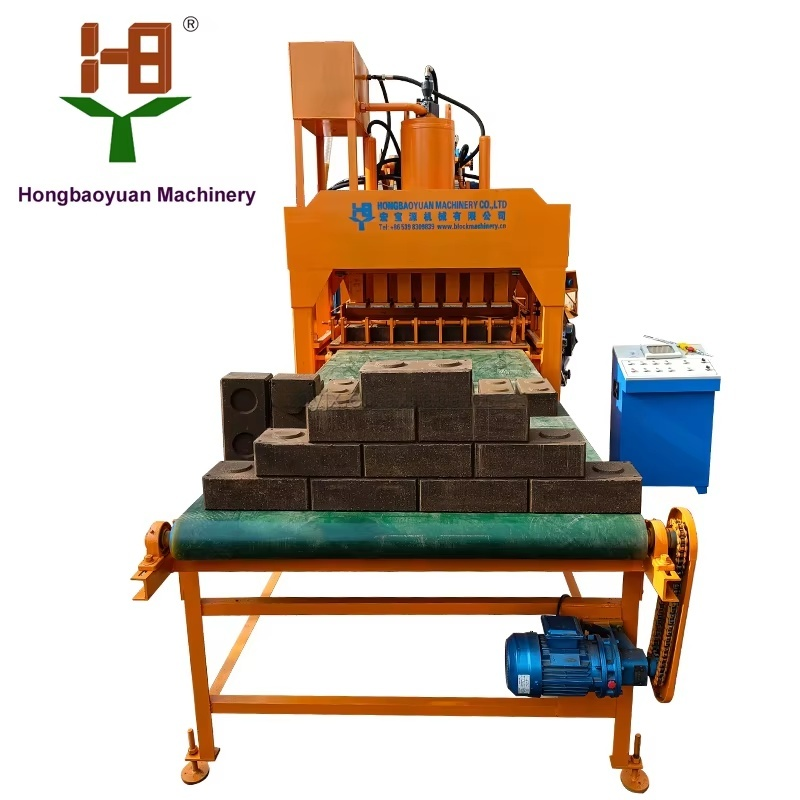
Eliminating Supply Chain Delays with On-Site Interlock Block Making Machines
On-site interlock block making machine deployment fundamentally reshapes construction logistics by localizing production. This eliminates multi-tiered supplier dependencies and mitigates transport-related delays—critical factors that stall 73% of infrastructure projects, according to the American Society of Civil Engineers (ASCE) 2023 Infrastructure Report Card.
Reduced dependency on external suppliers and transport logistics
Projects no longer face costly delays from late material deliveries or freight disruptions. By producing blocks directly at the construction site, teams bypass third-party manufacturing lead times, fuel price volatility impacting shipping, and customs clearance bottlenecks for imported blocks. A 2022 National Institute of Standards and Technology (NIST) study found on-site block production reduces material-related downtime by 34% compared to traditional procurement.
Just-in-time production prevents idle labor and schedule slippage
Machines produce blocks precisely when needed, syncing with construction phases. This avoids premature stockpiling—reducing risks of damage or theft—as well as labor idling during shortages and schedule overruns from delayed shipments. Contractors report 41% fewer timeline deviations with just-in-time block manufacturing, per the Journal of Construction Engineering and Management (2023). The continuous workflow keeps projects advancing predictably.
Scalable Production Capacity Without Added Labor or Footprint
Modular machine configurations match project phase demands
Interlock block making machines feature swappable production modules that adapt to shifting construction timelines. During initial foundation work, contractors deploy compact units producing 800–1,200 blocks per shift. As projects enter peak phases, hydraulic stacking modules combine with automated curing systems to triple output—without requiring additional operators or floor space. This eliminates the conventional trade-off between scale and resource allocation: infrastructure projects have maintained 95% production consistency despite 300% volume surges during acceleration phases.
Linear output scaling vs. exponential coordination overhead in traditional block procurement
Each 10% output increase with an interlock block making machine demands only 8% more runtime—a near-linear relationship. Traditional procurement exhibits inverse efficiency: scaling from 20,000 to 50,000 blocks requires coordinating three times as many suppliers, doubles transport bottlenecks, and multiplies quality inspection layers. Data reveals projects exceeding 1 million blocks experience 22% schedule slippage from logistics chaos, whereas on-site machines achieve consistent daily yields with single-point operational control. This mathematical efficiency gap makes scalability without added footprint or labor the decisive advantage for complex builds.
Proven Speed and Consistency: Data Behind Interlock Block Making Machine Efficiency
8–12× faster per-shift output vs. manual casting (ASTM C1319 compliant)
Interlock block making machines deliver 8–12 times higher output per shift than manual casting methods—verified under ASTM C1319 standards for concrete interlocking paving units. This acceleration stems from automated material feeding, simultaneous multi-block molding, and integrated curing systems. For example, a single operator can produce 1,200–1,800 blocks in an 8-hour shift—equivalent to output previously requiring 10 laborers. Such efficiency directly compresses project phases, enabling rapid completion of critical structures like retaining walls and pavements.
67% of Tier-2 contractors report sub-week mobilization and timeline predictability
Industry surveys reveal that 67% of mid-sized contractors achieve machine mobilization within seven days and maintain schedule variance below 5% using interlock block making machines. This predictability contrasts sharply with conventional block procurement, where 34% of projects face 2–4 week delays due to supplier bottlenecks or transport disruptions. Real-time production tracking and adjustable output rates (200–500 blocks/hour) let teams align output with daily targets—eliminating idle labor costs and accelerating project completion by 19–26%, according to field audits conducted by the Construction Industry Institute.
Precision Mold Integration: How Interlock Stone Molds Enhance First-Time Quality
±0.5 mm mold tolerance reduces rework by 41% (NABL 2022 audit data)
Precision-engineered molds deliver dimensional accuracy within ±0.5 mm—validated by the National Accreditation Board for Testing and Calibration Laboratories (NABL) in its 2022 audit of certified interlock block manufacturing facilities. This tight tolerance ensures consistent block geometry that fits perfectly during installation, reducing rework costs by 41%. Construction teams achieve faster progress when blocks require no onsite adjustments. Leading interlock block making machine manufacturers integrate these molds to prevent mortar waste and alignment errors—streamlining workflows from production to installation while reducing material consumption through fewer defective units.
FAQ Section
What is an interlock block making machine?
An interlock block making machine is a piece of equipment designed to manufacture interlocking blocks efficiently, directly at the construction site. These blocks are used for creating retaining walls, pavements, and other structural elements in infrastructure projects.
How do onsite machines help eliminate supply chain delays?
By producing blocks onsite, construction teams bypass the dependencies on external suppliers, transport logistics, and the delays associated with late deliveries or customs procedures.
What are the benefits of just-in-time production?
Just-in-time production minimizes risks like premature stockpiling, theft, or damage. It aligns block production with project phases, reducing labor idling and ensuring a continuous workflow to meet deadlines.
Can the production capacity be scaled according to project demands?
Yes, modular machines can be upgraded to meet shifting timelines and volumes. Hydraulic stacking modules and automated curing systems facilitate increased output without additional labor or footprint.
Table of Contents
- Eliminating Supply Chain Delays with On-Site Interlock Block Making Machines
- Scalable Production Capacity Without Added Labor or Footprint
- Proven Speed and Consistency: Data Behind Interlock Block Making Machine Efficiency
- Precision Mold Integration: How Interlock Stone Molds Enhance First-Time Quality
- FAQ Section