
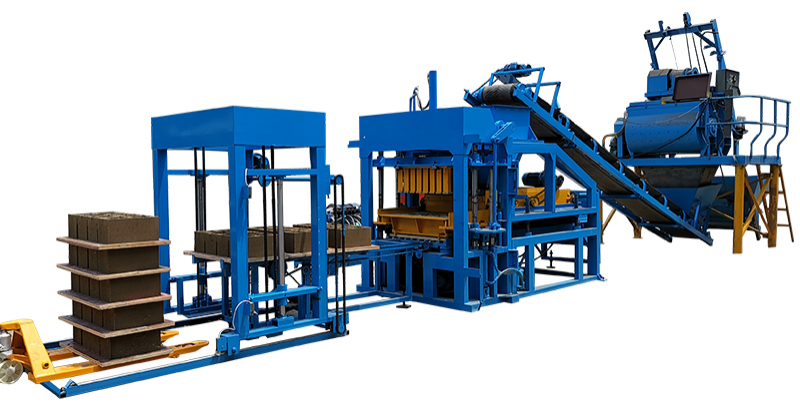
Superior Block Quality and Consistency via Cement Block Making Machine
Precision engineering for uniform density, dimensional accuracy, and batch-to-batch repeatability
Today's cement block makers rely on precision engineering to produce blocks that are consistently strong and reliable. The automated batching systems keep material mix ratios accurate to within about 1% - something that would be nearly impossible to match manually. When it comes to mold control, computer systems can maintain dimensions to within half a millimeter over thousands of blocks. This level of accuracy means blocks fit together perfectly without needing adjustments at the construction site. The machines combine vibration techniques with hydraulic pressure to create uniform density throughout each block, which gets rid of those weak spots that happen when materials consolidate unevenly. Behind the scenes, programmable logic controllers constantly watch over all aspects of production, making tiny adjustments as needed so that blocks made today will still match ones produced months later. For big projects that unfold over time, this kind of consistency between different shipments makes all the difference in maintaining structural integrity while keeping construction moving smoothly. And let's not forget the bottom line benefits either. Manufacturers report around a 22% drop in wasted materials compared to older manual methods, without sacrificing anything in terms of how well the blocks hold up.
Vibration compaction and hydraulic pressure: how they enhance compressive strength and structural integrity
High-frequency vibration compaction removes entrapped air and optimizes particle packing, increasing green density by 15–30%. This denser, more homogeneous matrix significantly improves final compressive strength. Hydraulic pressure—applied at 2,000–3,500 PSI—further consolidates the mixture, locking particles into place before curing. Together, these forces create blocks with superior mechanical properties:
| Property | Manual Method | Machine Production |
|---|---|---|
| Compressive Strength | 3–5 MPa | 7–12 MPa |
| Water Absorption | 12–18% | 5–8% |
| Density Variance | ±8% | ±1.5% |
This optimized microstructure enhances resistance to seismic stress, freeze-thaw cycling, and long-term environmental exposure—contributing to building lifespans extended by decades and reduced lifecycle maintenance costs.
Proven Durability: Long-Term Performance of Machine-Made Concrete Blocks
20-year lifecycle data from coastal and arid environments: corrosion resistance, moisture stability, and weathering performance
Field tests spanning twenty years in various climate conditions have shown that factory-produced concrete blocks last remarkably well. Along coastlines where salt is constantly present, these blocks lost less than 5% of their strength after two decades, which beats what we see with blocks made by hand. The reason? They resist corrosion better because they're less porous. When machines vibrate the mix, it creates about 92% uniform density throughout, so water gets absorbed around 40% less than when workers tamp them down manually. For areas that experience wild temperature swings like deserts do, with thousands of heating and cooling cycles each year, the controlled pressure from hydraulics during setting reduces tiny cracks forming right from the start. This means structures stay intact longer without those annoying flakes coming off surfaces or white salt deposits appearing later on. What makes all this work isn't just about good materials, but also how consistently manufacturers can recreate ideal compaction conditions batch after batch.
ASTM C140-validated impact resistance, freeze-thaw resilience, and abrasion tolerance
Independent testing according to ASTM C140 standards shows our products deliver top tier performance across the board. Our machine made blocks can handle well over 400 freeze thaw cycles before showing any signs of spalling, which actually beats the standard requirement of 250 cycles needed for areas with harsh weather conditions. When it comes to impact resistance, we're measuring around 18 MPa, which puts us right at or above what most countries require for structural masonry work. We did some abrasion tests too, and found our surfaces only wore down by less than 0.15mm after spinning through 50,000 rotations. That kind of durability matters a lot for things like sidewalks, retaining walls, and factory floors where constant traffic takes its toll. What makes all this possible? Our automated curing system with built in sensors takes out the guesswork humans bring to the table, like when exactly to remove blocks from molds or how much moisture they should retain during processing.
Scalable Production Speed and Operational Efficiency with Cement Block Making Machine
Throughput comparison: semi-automatic (200–800 blocks/hr) vs. fully automatic (1,500–3,000 blocks/hr) systems
Cement block makers can handle different amounts of work depending on what the job requires. The semi automatic models typically make between 200 to 800 blocks each hour, which works well for smaller projects where contractors need some flexibility but still want decent numbers. When it comes to fully automatic systems, these bad boys combine vibrating mechanisms, heavy presses, and robots that stack the blocks automatically, cranking out anywhere from 1500 up to 3000 blocks per hour. That kind of boost in production really helps with big construction sites needing materials right when they need them, cuts down on storage expenses, and keeps all those blocks looking and performing consistently throughout the whole batch without needing extra trained workers around. And here's something important too the machines maintain their quality no matter how fast they run because computer controls keep everything within tight specs for density, moisture content, and size measurements across the board.
Economic Advantages: Cost Savings and ROI in Large-Scale Construction
Labor reduction (up to 47%), material waste minimization (22%), and faster project timelines — evidence from NHB India case study (2023)
The switch to automated block production brings real money savings over time. When companies adopt this technology, they typically see labor needs fall around 47%. This means experienced workers can focus on more important jobs at the site instead of repetitive block making. Plus, there's less money spent on wages and training new staff. The machines also handle batching and compaction with such precision that raw material waste drops about 22%. Lower waste means cheaper blocks per unit, which helps meet those green procurement targets many businesses care about these days. What really makes a difference though is how fast these systems work. Fully automatic setups can crank out between 1,500 to 3,000 blocks every hour straight through without stopping or producing inconsistent quality. We saw this happen in real life too. According to a recent report from the National Housing Bank in India, construction firms that switched to automated block production finished their 500-unit affordable housing projects roughly 30% quicker than traditional methods. The savings on both labor and materials matched what financial analysts predicted, and most importantly, companies got their investment back in just under a year and a half.
FAQ
What are the benefits of using a cement block making machine?
The benefits include superior block quality and consistency, enhanced compressive strength, reduced material waste, cost savings, and faster construction timelines.
How does vibration compaction improve block quality?
Vibration compaction removes entrapped air and optimizes particle packing, resulting in a denser matrix that enhances compressive strength and durability.
What is the difference between semi-automatic and fully automatic cement block making systems?
Semi-automatic systems typically produce 200–800 blocks per hour, while fully automatic systems can produce up to 3,000 blocks per hour, offering higher efficiency and consistency.
Table of Contents
- Superior Block Quality and Consistency via Cement Block Making Machine
- Proven Durability: Long-Term Performance of Machine-Made Concrete Blocks
- Scalable Production Speed and Operational Efficiency with Cement Block Making Machine
- Economic Advantages: Cost Savings and ROI in Large-Scale Construction
- FAQ