
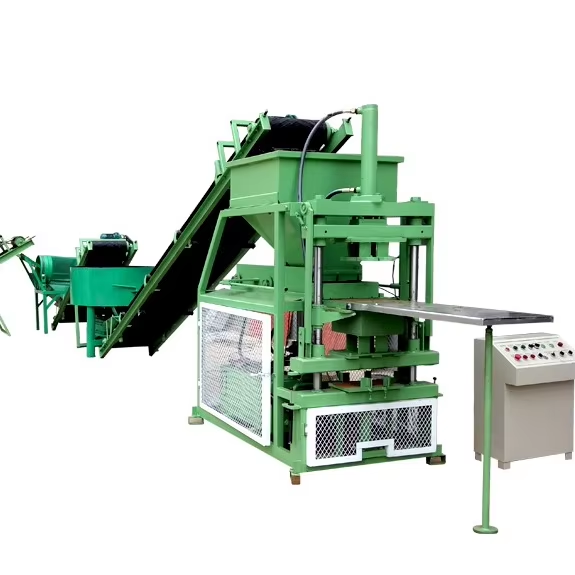
Precision Compaction: Hydraulic Force and Controlled Vibration
Physics of dual-force compaction: Eliminating air voids through synchronized hydraulic pressure and optimal 50–60 Hz vibration
Today's cement block makers tackle structural problems by mixing together intense hydraulic pressure over 1500 psi with vibrations set at around 50 to 60 hertz. This two part system pushes those little rock bits closer together and gets rid of all that pesky trapped air inside. According to research from last year, this cuts down on empty spaces inside blocks by about 15 percent when compared to older single action machines. The specific vibration frequencies we pick stop the different sized materials from separating out during production, which lets the big hydraulic rams create consistent density throughout the whole mold area. What happens next is pretty cool actually the cement mixture wraps around every single piece of aggregate properly, making blocks that resist water better and can handle much heavier loads without breaking apart.
ASTM C90 compliance: Achieving <3% variance in compressive strength and density across batches
When it comes to automated production lines, precision controlled compaction cycles really make a difference. They keep compressive strength variations down to less than 3% between different batches of concrete masonry units, which actually goes beyond what ASTM C90 standards require for load bearing applications. Modern factories now use real time sensors throughout the process. These sensors watch both the compaction force applied and how intense the vibrations are during manufacturing. If there's any variation in the raw materials coming in, the system adjusts on its own to maintain quality. The result? Most blocks show density differences of under 2.5% from one to the next. That means no unexpected weak spots showing up in walls later on. And let's not forget about the other benefits too. When density stays consistent across all units, buildings perform predictably when it comes to temperature control and noise reduction. For commercial projects where everyone expects materials to behave exactly as specified, this kind of consistency just makes good business sense.
Dimensional Precision: CNC Molds and Servo-Controlled Ejection
Tight ±1.2 mm Tolerance Enforcement for Uniform Geometry and Interlocking Fit
Modern cement block machines rely on CNC machined steel molds combined with servo driven ejection systems to achieve consistently accurate dimensions. These computer controlled tool paths maintain around ±1.2mm tolerance throughout production runs, something manual methods just can't match since they often vary by over 5mm between blocks. For interlocking designs specifically, these small differences really matter because even slight misalignments weaken the whole structure. The automated systems keep performing at this level for thousands of cycles thanks to built in adjustments that account for heat changes and component wear over time. What does this mean on site? Blocks fit together much better, cutting down on wasted mortar by roughly 15 to 20 percent according to research from the Masonry Institute back in 2023, and speeding up overall construction projects significantly.
Structural Impact: How Dimensional Consistency Improves Mortar Joint Uniformity and Load-Bearing Reliability
Keeping blocks at consistent sizes really boosts how well structures perform overall. When blocks are uniform in size, it makes those 8 to 10 mm mortar joints between them work properly. And this matters a lot since if the joints vary more than 3 mm thick, walls become about 30% weaker from concentrated stresses according to research from the Concrete Association back in 2023. The machines that push out finished blocks using servo control help prevent chips along edges, which keeps the blocks intact for longer. Even tiny differences matter when building things that need to hold weight. Just 2 mm off spec can cut down on load capacity by around 12%. That's why modern factories automate production so precisely. They make sure each block matches specifications exactly, resulting in buildings that meet safety codes and have strength characteristics everyone can count on.
Process Control from Mix to Cure: Automation-Driven Consistency
Real-time batching and moisture sensing: Maintaining ideal water-cement ratio (0.32–0.38) for strength and durability
Today's cement block makers keep structures strong thanks to automated systems that run everything from mixing ingredients all the way through the curing process. These machines have built-in sensors that check how wet the aggregates are constantly, so they can adjust water levels on the fly to hit that sweet spot between 0.32 and 0.38 water to cement ratio. No more guessing games here folks! According to NIST research from 2023, this approach cuts down water ratio mistakes by around 87% compared to old school methods. And when those sensors detect something off track, they fix it right away. Why does this matter? Well, if there's even 5% too much water in the mix, blocks end up 30% weaker according to studies published in the Journal of Materials in Civil Engineering last year. The benefits don't stop there either. Blocks made with this system show much better consistency too - only about 1.5% variation in strength compared to 18% when done manually. Plus, the curing process is far more uniform at 99.2% success rate versus just 76% with traditional approaches. All this means faster production times and blocks that stand the test of time because the chemical reactions during curing happen properly every single time.
Consistency Improvements Through Automation
| Parameter | Automated System | Manual Method | Variance Reduction |
|---|---|---|---|
| Water-cement ratio | ±0.02 | ±0.15 | 87% (NIST 2023) |
| Compressive strength | 1.5% variance | 18% variance | 92% (PCA 2024) |
| Cure uniformity | 99.2% | 76% | 30% productivity gain |
Proven Performance Gap: Cement Block Making Machine vs. Manual Production
The switch to automated cement block manufacturing brings some pretty significant benefits when it comes to how fast things get done, the quality of what gets produced, and overall costs. Machines can crank out around 1,500 blocks every hour, which is roughly 20 times quicker than doing it manually according to Ponemon's 2023 report. This speed cuts down on project timelines by nearly three quarters while keeping dimensions within about 1.2 mm and ensuring compressive strength stays below 3% variation. Manual methods tell a different story though. Workers struggle with getting consistent results because vibrations, compaction levels, and moisture control just don't stay the same throughout the process. The end result? Blocks that vary in density by more than 15% and shapes that aren't quite right, making structures less reliable. These issues show up as wobbly mortar joints and weak spots where weight isn't distributed properly, problems that lead to failures in the field. Plus, automation means needing far fewer workers too. Labor requirements drop by about 80%, and there's practically no waste anymore since materials aren't spilled or rejected as much. All this adds up to lifetime costs that are somewhere between 40% and 60% lower compared to traditional labor-heavy approaches.
FAQ
What are the main advantages of automated over manual cement block production?
Automated production offers faster manufacturing speeds, consistent quality, reduced labor requirements, and lower overall costs compared to manual production.
How do machines ensure dimensional accuracy during cement block production?
Machines use CNC machined steel molds and servo-controlled ejection systems to maintain ±1.2mm tolerance throughout production, significantly improving accuracy over manual methods.
Why is maintaining a consistent water-cement ratio important in block production?
A consistent water-cement ratio ensures optimal strength and durability of the blocks; deviations can significantly weaken the blocks.
How does automation improve cure uniformity in cement block production?
Automated systems monitor moisture and curing processes in real-time, ensuring a 99.2% success rate compared to 76% with traditional methods.
Table of Contents
- Precision Compaction: Hydraulic Force and Controlled Vibration
- Dimensional Precision: CNC Molds and Servo-Controlled Ejection
- Process Control from Mix to Cure: Automation-Driven Consistency
- Proven Performance Gap: Cement Block Making Machine vs. Manual Production
-
FAQ
- What are the main advantages of automated over manual cement block production?
- How do machines ensure dimensional accuracy during cement block production?
- Why is maintaining a consistent water-cement ratio important in block production?
- How does automation improve cure uniformity in cement block production?